Overview
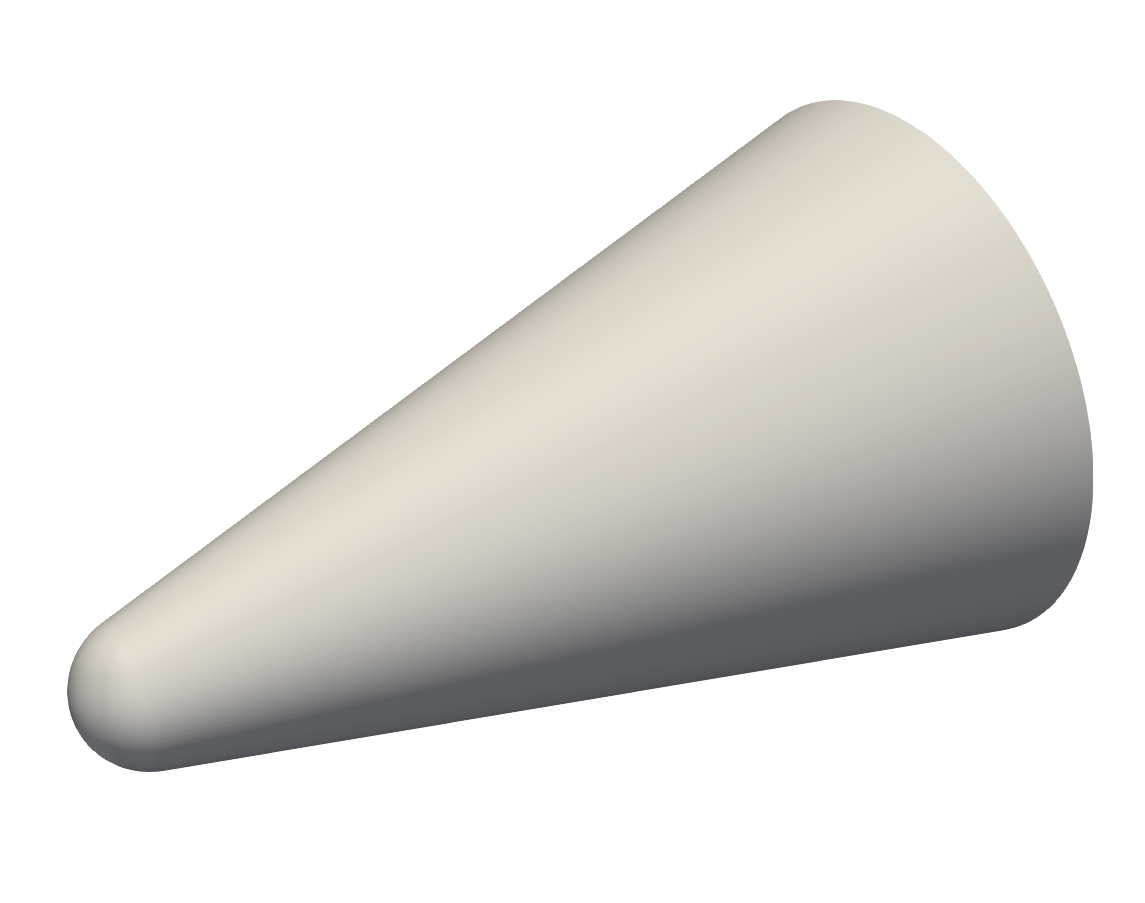 Geometry overview for blunt cone at 20° angle-of-attack
This test case is a blunted cone at Mach 6 and 20° angle of attack. The cone half angle is 15° and the nose radius is Rnose = 22.45mm. In this tutorial you will run an inviscid computation and extract heat transfer data using the approximate Integral-Boundary-Layer (IBL) method, which is a useful method to rapidly extract laminar, transitional and turbulent heat transfer.
In this tutorial, you’ll learn how to:
- Setup and run an inviscid computation with CHAMPS+
- Add options to the input file for running the IBL (laminar, transitional or turbulent)
- Post-process IBL data in Paraview: extract surface streamlines, heating rates, etc.
- Look at force and moment coefficients.